![Bill of Sale Florida For Car, Vehicle [Edit & Printable] PDF](https://billofsaleflorida.com/wp-content/uploads/2025/11/cropped-Bill-of-sale-florida-logo-160x74.png)
When Florida residents search for a Simple Bill of Sale Florida guide, they’re usually looking for one thing: clear, reliable steps to document a private sale—whether it’s a car, boat, trailer, or other personal property. A bill of sale protects both parties. It proves ownership transfer, helps avoid future liability, and supports DMV/title paperwork.
Under Florida law, especially Florida Statutes §319.23 and §319.27, documenting a sale properly is essential for a clean title transfer.

This article is for informational purposes only and does not constitute legal advice. For advice specific to your situation, consult a qualified attorney.
Free Simple Bill of Sale Florida Templates
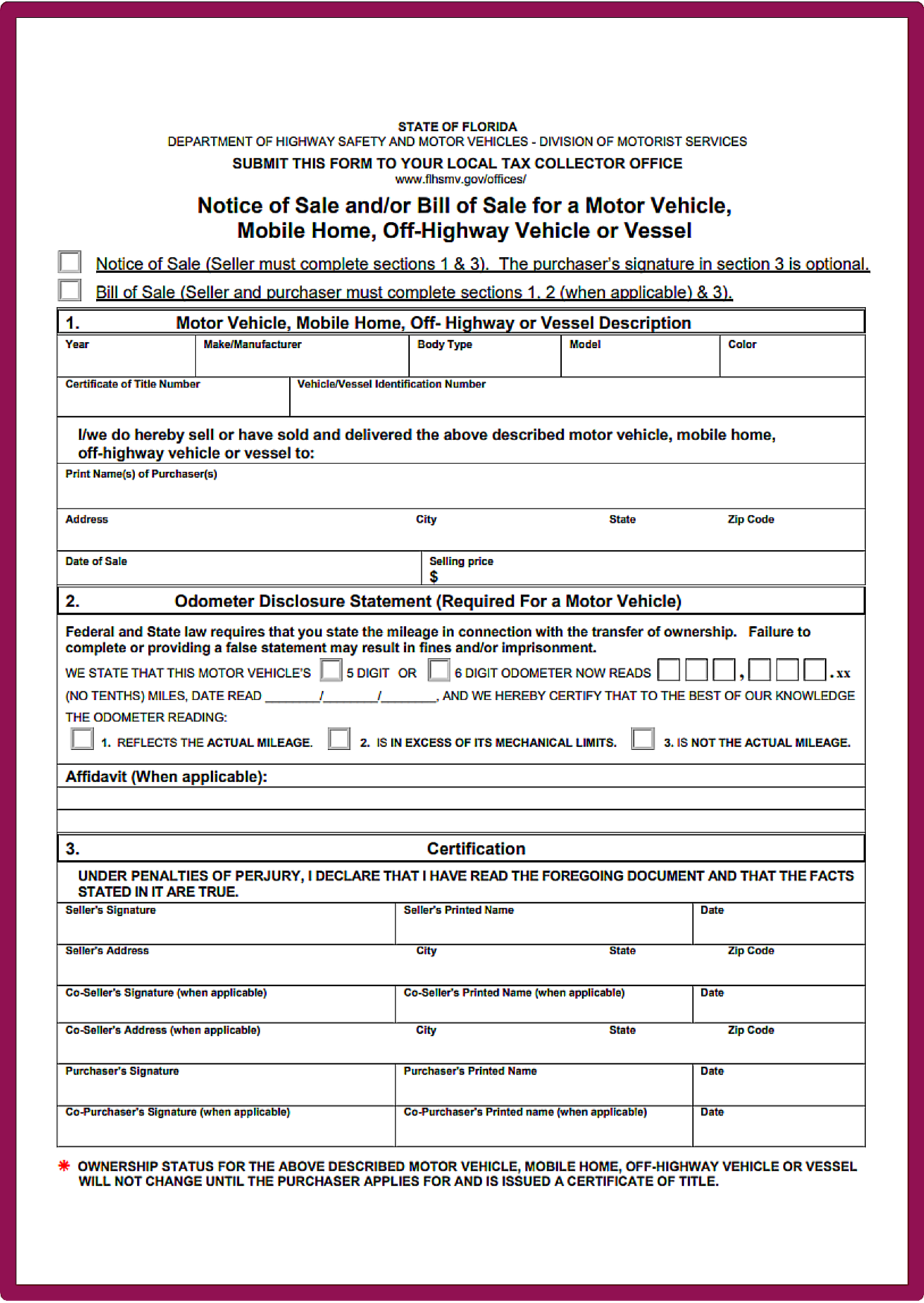
If you’re looking for Free Simple Bill of Sale Florida Templates, you’re in the right place. I’ve put together easy-to-use, Florida-compliant templates that make documenting your sale quick, accurate, and stress-free. Whether you’re selling a car, boat, trailer, or any personal property, these forms follow Florida’s basic legal requirements—so you can confidently record the transfer.
I’m also including both PDF and Word (.docx) versions, so you can download whichever format works best for you. Just fill in the blanks, print, and you’re ready to go.
Florida Simple Bill of Sale: Notice of Sale and Seller Protection
| Topic / Issue | [FLORIDA] Legal Rule | Governing Statute |
|---|---|---|
| Governing Legislation | Motor vehicle and personal-property title matters are governed by Florida Statutes Chapter 319, including title applications, liens, and odometer disclosures. | Florida Statutes Chapter 319 |
| Title Application | Florida law governs the application for and issuance of a certificate of title and acceptance of a Bill of Sale or sworn statement of ownership. | Florida Statute § 319.23 |
| Liens | Florida law governs notice of liens, their notation on the certificate of title, and recording of liens. | Florida Statute § 319.27 |
| Odometer Disclosure | Florida governs transfer and reassignment forms and odometer disclosure statements. | Florida Statute § 319.225 |
| Sales Tax | Florida imposes state sales tax on applicable transactions. | Florida Statute § 212.05 |
| Discretionary Surtax | Florida imposes a discretionary sales surtax. | Florida Statute § 212.054 |
| Warranty Disclaimer | A conspicuous “As Is” or “With All Faults” clause may exclude implied warranties of merchantability and fitness in a private sale. | Florida Statute § 672.316 |
| Federal Odometer Law | Federal law establishes mandatory odometer disclosure standards through the Truth in Mileage Act and 49 C.F.R. Part 580. | 49 U.S.C. § 32705; 49 C.F.R. Part 580 |
| Odometer Amendment | The federal odometer exemption threshold was expanded from 10 years to 20 years, effective January 1, 2021. | 49 C.F.R. Part 580 |
| Authorized Signers | If multiple titled owners are joined by “AND,” all must sign. If joined by “OR,” any one owner may sign. Buyers must sign when an odometer disclosure is required. | Florida Statute § 319.22(2)(a) |
| Witnesses | No statutory witness requirement. | N/A |
| Notarization | No statutory notarization requirement. | N/A |
| Age | Parties must be at least 18 years old to possess legal contractual capacity. | Florida Statute § 743.07 |
| Mental Capacity | No statutory requirement. | N/A |
| Buyer Filing Deadline | The purchaser must file the title transfer application within 30 calendar days after the date of delivery. | Florida Statute § 319.23(6)(a) |
| Seller Notice Deadline | The seller should submit a Notice of Sale within 30 days to extinguish statutory civil liability. | Florida Statute § 319.22(2) |
| Odometer Certification | For non-exempt vehicles, the document must state the exact numeric reading and certify whether it is actual mileage, exceeds mechanical limits, or is not actual mileage. | Florida Statute § 319.225; 49 C.F.R. § 580.5 |
| Filing Agency | The local County Tax Collector’s Office acts as the authorized agent for the Florida Department of Highway Safety and Motor Vehicles (FLHSMV). | Florida Department of Highway Safety and Motor Vehicles |
| Notice of Sale | The seller must file Form HSMV 82050 with the Tax Collector to mark the record as “sold” and terminate civil liability. | Florida Statute § 319.22(2) |
| Fraudulent Information | Falsifying the purchase price to evade sales tax, forging a title owner’s signature, or altering a VIN is a criminal felony and renders the transfer legally void. | Florida Statute § 319.33 |
| Unsatisfied Lien | A seller cannot legally convey marketable, unencumbered title if an unsatisfied lien exists on the certificate of title. | Florida Statute § 319.27 |
| Missing Odometer Certification | A transfer for a non-exempt vehicle without the required odometer certification causes FLHSMV to reject the application. | Florida Statute § 319.225; 49 U.S.C. § 32705 |
| License Plates | Motor vehicle and trailer license plates belong to the registered owner, not the vehicle. The seller must remove and retain or surrender the plate before delivery. | Florida Statute § 320.0609 |
| Dangerous Instrumentality Liability | A private Bill of Sale does not itself sever Florida’s Dangerous Instrumentality Doctrine liability. The seller must formally file the Notice of Sale to obtain the stated statutory protection. | Florida Statute § 319.22(2); Aurbach v. Gallina, 753 So. 2d 60 (Fla. 2000) |
| Jurisdiction | Florida statutes govern titling, registration, liens, and taxation, while federal law governs odometer disclosure standards. | Florida Statutes Chapters 319, 212, and 672; 49 U.S.C. § 32705; 49 C.F.R. Part 580 |
A simple Bill of Sale does more than record the price and signatures. For a Florida vehicle transaction, the seller still has a separate Notice of Sale responsibility. The supplied research states that the seller should submit the notice within 30 days, and that Form HSMV 82050 is used to mark the state record as sold. That step matters because a private Bill of Sale by itself does not sever the seller’s stated Dangerous Instrumentality Doctrine liability.
The title paperwork also needs to be accurate. If owners are listed with “AND,” every titled owner must sign. If they are joined by “OR,” one owner may sign. For a non-exempt vehicle, the odometer disclosure must give the exact reading and the required certification.
Getting these details wrong can lead to a rejected title application, continuing liability concerns, or a legally defective transfer. The safest approach is to keep the Bill of Sale accurate and complete the separate Florida filing steps as required.
Car Simple Bill of Sale Florida

When you’re selling or buying a car privately in Florida, having a Car Simple Bill of Sale Florida document is one of the easiest ways to protect both parties and keep the transaction legally clean. As a Florida attorney, I always remind clients that this simple form helps prove ownership transfer, prevents future liability, and supports the buyer at the Tax Collector or FLHSMV office when registering the vehicle. In this guide, I’ve also included both PDF and Word format versions of the bill of sale, so you can download whichever format works best for you.
Simple Florida Firearm Bill of Sale

If you’re buying or selling a firearm in Florida, a Simple Florida Firearm Bill of Sale is one of the most important documents you can use to protect both parties. It records the details of the firearm, confirms the transfer of ownership, and helps ensure the sale complies with Florida law. While Florida does not require private sellers to register firearms, creating a proper bill of sale is a smart way to document the transaction clearly and safely.
In this guide, I’ve also included both PDF and Word formats of the Simple Florida Firearm Bill of Sale, so you can download whichever version works best for you in English.
Printable Simple Bill of Sale Florida

If you’re looking for a quick and reliable Printable Simple Bill of Sale Florida, you’re in the right place. A bill of sale is one of the easiest ways to protect yourself when buying or selling a car, boat, trailer, or any personal property in Florida. It clearly records the details of the transaction and helps both parties avoid future disputes or confusion.
To make things even easier, I’ve included both PDF and Word format versions of the Florida Bill of Sale. You can download whichever format works best for you—print it, fill it out, and you’re ready to go.
What Is a Bill of Sale in Florida?
A Bill of Sale in Florida is a legal document that records the transfer of ownership of personal property from a seller to a buyer. It includes essential information such as the purchase price, date of sale, VIN (for vehicles), and signatures.
Florida Statutes that Apply
-
Florida Statute §319.23 – Outlines the requirements for applying for a new title after a sale.
-
Florida Statute §319.27 – Explains liens, ownership rights, and the legal responsibilities related to titled property.
Why It Matters
In my legal practice, I often see clients run into trouble months after selling a vehicle because they never documented the sale correctly. A bill of sale helps:
-
Prove the exact date you released the vehicle
-
Prevent future liability (tolls, accidents, tickets)
-
Support the buyer when registering the vehicle with FLHSMV
Is a Bill of Sale Required in Florida?
Contrary to what many believe, Florida does not always require a bill of sale. But in several situations, it becomes highly important or mandatory.
When It Is Mandatory
-
When you sell a vehicle, vessel, or mobile home and need to document the purchase price for taxes.
-
When a Tax Collector’s office requests proof of purchase.
-
When the buyer wants to register and title the vehicle without the seller present.
-
When there’s no title available (e.g., for certain trailers under 2,000 lbs).
When It Is Optional But Recommended
Even if both parties meet at the Tax Collector together, a bill of sale is wise.
In my experience, optional or not, it protects you from:
-
Improper use of your old license plate
-
Unpaid tolls
-
Fraudulent claims
Step-by-Step Process to Complete a Bill of Sale
Step 1 – Gather Identification Information
Collect the full legal names and addresses of both parties. Verify IDs.
Step 2 – Identify the Property
For vehicles, include:
-
Year, Make, Model
-
Body Type
-
VIN (Vehicle Identification Number)
For boats, include: -
Hull Identification Number (HIN)
Step 3 – Specify the Purchase Price
Document the exact amount agreed. Florida uses this to calculate sales tax.
Step 4 – Add Odometer Disclosure (If Required)
Under federal and Florida law, odometer disclosure is required for most vehicles under 20 years old.
Step 5 – Signatures
Both buyer and seller must sign. Digital signatures are acceptable if both agree.
Step 6 – Keep Copies
I advise keeping a copy for at least five years.
Key Legal Requirements in Florida
VIN Verification
Florida requires VIN verification for certain out-of-state vehicles.
Odometer Disclosure
Failure to disclose mileage properly can lead to:
-
Title delays
-
Civil penalties
-
Fraud charges (in extreme cases)
Notary Requirements
Florida does not require a bill of sale to be notarized—
but many Tax Collector offices prefer it, especially for boats or unclear documentation.
Florida Tax Collector Submission
The buyer must submit title paperwork to the County Tax Collector or FLHSMV office within 30 days of purchase.
Failure to do so results in late transfer penalties.
Florida Bill of Sale as Proof of Ownership
A Florida Bill of Sale can have a more specific role when the buyer is applying for a certificate of title. Under Florida Statute § 319.23, the title-application process includes acceptance of a Bill of Sale or sworn statement of ownership as evidence supporting the ownership application. That makes the document more than a private receipt between the buyer and seller.
This becomes particularly useful when the ordinary title paperwork does not fully establish the ownership history. The supplied Florida requirements specifically identify a Bill of Sale or sworn ownership statement within the certificate-of-title process.
For that reason, the information written on a Simple Bill of Sale should match the ownership information being submitted with the title application. Names, property identification, purchase information, and signatures should be consistent across the documents. A mismatch can create questions when the County Tax Collector’s Office reviews the ownership paperwork.
The Bill of Sale also should not be treated as a universal substitute for a certificate of title. Where Florida requires title documentation, the Bill of Sale supports the ownership application rather than eliminating the separate title-transfer process.
Example or Template of a Florida Bill of Sale
Below is a simple, legally compliant format:
Simple Bill of Sale Florida – Template
1. Buyer Information:
Name: __________________________
Address: ________________________
2. Seller Information:
Name: __________________________
Address: ________________________
3. Property Description:
(Example for vehicle):
Year: _____ Make: _____ Model: _____
VIN: __________________________
4. Purchase Price:
$________________ (Paid on: //____)
5. Odometer Disclosure:
Mileage at time of sale: _______________
I certify this reading is accurate.
Seller Initials: _______
6. “As-Is” Statement:
The property is sold AS-IS, without warranties.
7. Signatures:
Seller Signature: ___________________
Buyer Signature: ___________________
Date: //____
Common Errors or Legal Pitfalls In Florida Bill of Sale Transactions
Missing Odometer Disclosure
In my legal practice, this is the #1 mistake. It leads to delays at FLHSMV.
Incorrect VIN
A single digit error can prevent the buyer from registering the vehicle.
Not Reporting the Sale to FLHSMV
Sellers should submit a Notice of Sale (Form HSMV 82050) to protect themselves.
Using Informal Handwritten Notes
These often leave out required elements.
No Proof of Payment
Always document payment method—cash, check, digital.
FAQs
Do I Need a Bill of Sale to Sell a Car in Florida?
Not always legally required, but strongly recommended and sometimes required by the Tax Collector.
Can I Use a Handwritten Bill of Sale?
Yes, as long as it includes all required details, including VIN and odometer.
Do I Need a Notary?
Generally no, but some counties prefer it.
Does a Bill of Sale Replace a Title?
No. You must still sign and transfer the certificate of title.
Can I Download a Simple Bill of Sale Florida Form?
Yes. Many counties offer free PDFs, and you can download the official FLHSMV forms online.
Conclusion
A Simple Bill of Sale Florida document is one of the easiest ways to protect both buyers and sellers during a private transaction. By including the VIN, odometer reading, price, and accurate signatures, you ensure a clean transfer that complies with Florida law.
If you want a ready-to-use, attorney-reviewed version, you can now:
Download your free Florida Bill of Sale template.
And remember: This article is for informational purposes only and does not constitute legal advice. Consult a qualified attorney for advice tailored to your situation.

Alexander Nobregas, Esq.
Florida Attorney & Legal Documentation Specialist
Alexander Nobregas is a licensed attorney based in Florida, United States, focusing on consumer law, property transfers, and legal documentation. He has extensive experience helping Florida residents navigate private sales, title transfers, DMV requirements, and ownership verification issues.
Through BillofSaleFlorida.com, Alexander provides clear, accurate, and practical guidance on bills of sale and Florida compliance rules—making legal processes easier for everyday buyers and sellers. His articles are based on real-world cases, Florida Statutes, and years of hands-on legal experience.