![Bill of Sale Florida For Car, Vehicle [Edit & Printable] PDF](https://billofsaleflorida.com/wp-content/uploads/2025/11/cropped-Bill-of-sale-florida-logo-160x74.png)
Bills of sale are commonly used across Florida to document ownership transfers. However, many residents assume that one bill of sale template works for every type of transaction. In reality, vehicle, boat, and firearm bills of sale each serve different legal and compliance purposes.
Understanding these differences helps buyers and sellers stay compliant with Florida regulations and avoid costly legal mistakes.
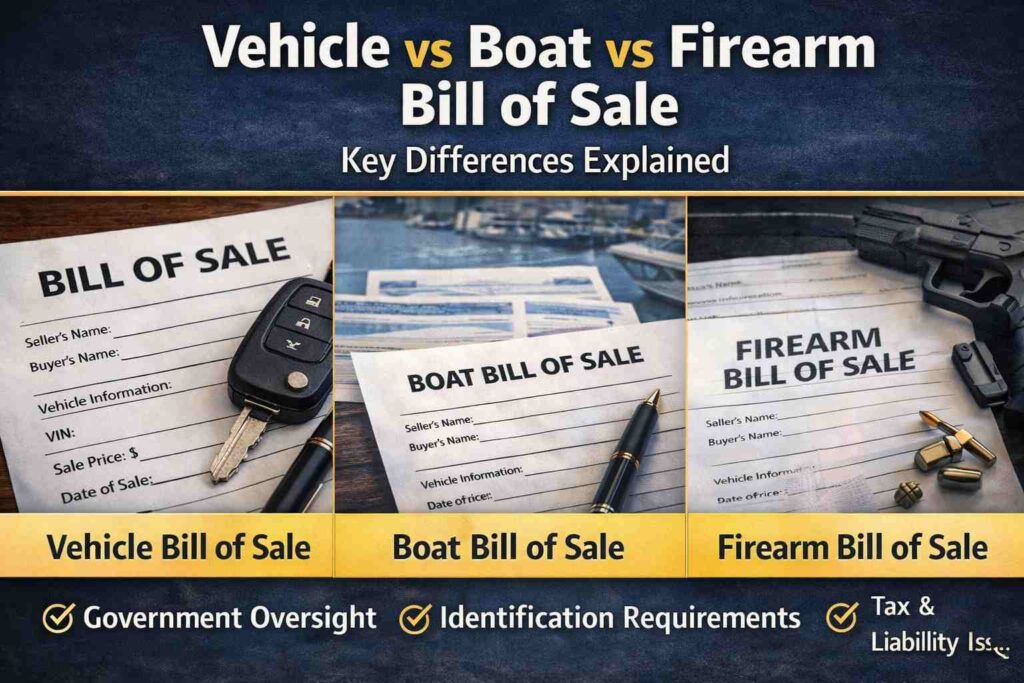
Vehicle Bill of Sale
A vehicle bill of sale documents the private sale of cars, trucks, motorcycles, and other road vehicles. In Florida, vehicle ownership is primarily transferred through a title, but a bill of sale serves as critical supporting documentation.
Legal Purpose
A vehicle bill of sale helps verify:
- Date of ownership transfer
- Purchase price for tax calculation
- Buyer and seller identification
- Vehicle condition and sale terms
The document is often used during title transfer processing handled by the Florida Department of Highway Safety and Motor Vehicles.
Required Information
A Florida vehicle bill of sale typically includes:
- Vehicle Identification Number (VIN)
- Year, make, and model
- Odometer reading
- Purchase price
- Sale date
- Buyer and seller signatures
Why It Matters
Vehicle bills of sale are especially important when:
- The buyer delays registration
- Traffic violations occur after sale
- The title contains errors
- The sale is completed “as-is”
Without documentation, sellers may struggle to prove when ownership legally transferred.
Boat Bill of Sale
Boat bills of sale are frequently required in Florida because marine ownership records are handled differently than motor vehicles. Boats and vessels often require separate registration and taxation procedures.
Legal Purpose
A boat bill of sale helps:
- Establish vessel ownership
- Confirm sales tax liability
- Register boats and marine equipment
- Provide proof of lawful transfer
Required Information
Florida boat bills of sale commonly include:
- Hull Identification Number (HIN)
- Vessel make, model, and length
- Outboard motor serial number (if applicable)
- Purchase price
- Registration details
- Buyer and seller signatures
Why It Matters
Boat transactions often involve large financial investments. A detailed bill of sale protects buyers from ownership disputes and helps sellers demonstrate they transferred responsibility for the vessel.
Firearm Bill of Sale
Florida does not require firearm registration at the state level, but many private buyers and sellers still use firearm bills of sale to document ownership transfers.
Legal Purpose
Firearm bills of sale help:
- Establish lawful transfer date
- Document buyer and seller identity
- Provide evidence in case of future liability questions
- Support lawful private sales
Required Information
A firearm bill of sale usually includes:
- Firearm manufacturer and model
- Serial number
- Caliber or gauge
- Purchase price
- Buyer and seller identification
- Sale date and signatures
Why It Matters
Because firearm ownership can carry serious legal responsibility, documenting the transfer helps protect sellers from liability if the firearm is later misused or involved in an investigation.
Key Differences Between Vehicle, Boat, and Firearm Bills of Sale
| Feature | Vehicle | Boat | Firearm |
|---|---|---|---|
| Primary Government Oversight | DMV / Highway Safety | Marine Registration Agencies | Generally Private Transfer |
| Title Requirement | Usually required | Sometimes required | Not required in Florida |
| Identification Number | VIN | Hull Identification Number (HIN) | Serial Number |
| Tax Verification | Yes | Yes | Usually No |
| Registration Requirement | Required | Required | Not required statewide |
| Liability Protection | Very important | Very important | Critical for legal protection |
Which Bill of Sale Requires the Most Detail?
From a compliance standpoint:
- Boat bills of sale often require the most technical identification details.
- Vehicle bills of sale require tax and title coordination.
- Firearm bills of sale require careful documentation for liability protection.
Each document serves a unique legal function, even though they share similar structure.
Can You Use One Template for All Transactions?
Using a generic bill of sale template is not recommended. Each type of transaction requires specific details that may not be included in a universal form.
Incomplete documentation may:
- Delay registration
- Create tax issues
- Increase liability risk
- Weaken legal protection during disputes
Using transaction-specific forms ensures compliance with Florida expectations.
Attorney Guidance on Choosing the Right Bill of Sale
From a legal perspective, using the correct type of bill of sale helps establish clear ownership records and prevents misunderstandings. Buyers and sellers should always match the document to the type of property being transferred.
Even when Florida law does not require a bill of sale, properly documenting a transaction provides strong legal protection and helps avoid disputes.
Final Takeaway
Vehicle, boat, and firearm bills of sale may appear similar, but each serves a different legal and regulatory role in Florida. Understanding these differences helps ensure transactions remain legally compliant, properly documented, and fully protected.
Choosing the correct bill of sale is one of the simplest steps individuals can take to safeguard ownership rights and avoid future legal complications.

Alexander Nobregas, Esq.
Florida Attorney & Legal Documentation Specialist
Alexander Nobregas is a licensed attorney based in Florida, United States, focusing on consumer law, property transfers, and legal documentation. He has extensive experience helping Florida residents navigate private sales, title transfers, DMV requirements, and ownership verification issues.
Through BillofSaleFlorida.com, Alexander provides clear, accurate, and practical guidance on bills of sale and Florida compliance rules—making legal processes easier for everyday buyers and sellers. His articles are based on real-world cases, Florida Statutes, and years of hands-on legal experience.