![Bill of Sale Florida For Car, Vehicle [Edit & Printable] PDF](https://billofsaleflorida.com/wp-content/uploads/2025/11/cropped-Bill-of-sale-florida-logo-160x74.png)
A bill of sale is one of the most misunderstood legal documents in Florida. Many buyers and sellers assume it is either always required or completely optional. The reality is more nuanced.
Florida law treats a bill of sale as a supporting legal document—one that may not always be mandatory, but often becomes essential when disputes, audits, or ownership questions arise.
This guide explains how Florida bill of sale laws actually work, when a bill of sale is required, and how it protects both parties in real-world situations.
What Is a Bill of Sale Under Florida Law?
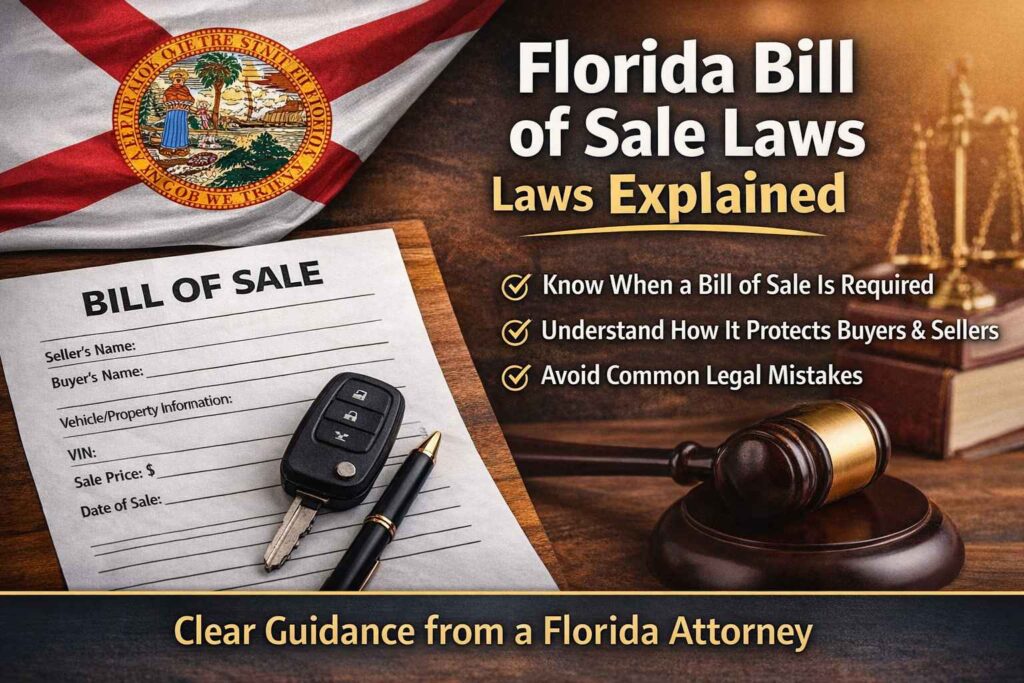
A bill of sale is a written legal record that documents:
- The transfer of ownership
- The date of the transaction
- The purchase price
- The parties involved
In Florida, a bill of sale does not replace a title, deed, or registration document. Instead, it serves as evidence of the transaction itself.
Courts, tax collectors, and state agencies routinely rely on bills of sale when:
- Ownership is disputed
- Sale details are questioned
- A title is lost, delayed, or incorrectly completed
Does Florida Law Require a Bill of Sale?
Florida does not have a single statewide law requiring a bill of sale for every transaction. Whether one is required depends on what is being sold and how the transaction is handled.
Vehicles
For private vehicle sales, Florida law primarily requires a properly assigned title. However, the Florida Department of Highway Safety and Motor Vehicles strongly recommends a bill of sale to document the sale price and transfer date.
A bill of sale becomes especially important if:
- The vehicle is sold “as-is”
- The title contains errors
- The buyer delays registration
- The seller needs proof the vehicle was sold
Boats and Vessels
In Florida, bills of sale are commonly required for:
- Boats
- Vessels
- Outboard motors
These transactions often involve:
- Separate ownership records
- Registration with state agencies
- Sales tax verification
A bill of sale is frequently used as the primary proof of ownership transfer in marine transactions.
Firearms (Private Sales)
Florida does not require firearm registration at the state level, but a bill of sale is often used in private firearm transactions to:
- Document lawful transfer
- Establish date of ownership change
- Provide protection if questions arise later
While not mandatory, it is considered best legal practice.
Personal Property and Equipment
Bills of sale are widely used—and often expected—for:
- Trailers
- RVs
- Motorcycles
- ATVs
- Business equipment
- High-value personal property
In these cases, the bill of sale may be the only document proving ownership.
Why Florida Treats Bills of Sale as Important Evidence
Under Florida law, disputes are resolved using documented evidence. When ownership, timing, or payment is questioned, a signed bill of sale often becomes the most reliable proof available.
A bill of sale can establish:
- When legal responsibility ended
- Who assumed liability
- Whether the sale was legitimate
- Whether taxes were calculated correctly
In many court cases and administrative reviews, a bill of sale carries substantial evidentiary weight.
Is Notarization Required in Florida?
Notarization is not required for most Florida bills of sale.
However, notarizing a bill of sale can:
- Strengthen its credibility
- Reduce the risk of fraud claims
- Make disputes easier to resolve
Some buyers, lenders, or agencies may request notarization even when the law does not require it.
What a Valid Florida Bill of Sale Should Include
To comply with best legal practices, a Florida bill of sale should clearly include:
- Full legal names and addresses of both parties
- Detailed description of the item sold
- Vehicle or property identification numbers (VIN, HIN, serial number)
- Purchase price
- Date of sale
- “As-is” condition statement (if applicable)
- Signatures of buyer and seller
Missing or vague information can weaken the document’s legal value.
Common Legal Mistakes in Florida Sales
From a legal perspective, the most frequent issues arise when:
- The sale date is left blank
- Sale price is inaccurate or understated
- The seller fails to keep a copy
- The buyer delays registration
- Ownership is transferred verbally without documentation
These mistakes often lead to disputes that could have been avoided with a proper bill of sale.
How Florida Courts View Bills of Sale
Florida courts generally treat a bill of sale as:
- Supporting evidence, not a title substitute
- Proof of intent to transfer ownership
- Documentation of transaction terms
When paired with a title or registration record, a bill of sale significantly strengthens a party’s legal position.
Legal Guidance from a Florida Attorney
While Florida law does not mandate a bill of sale in every situation, using one is strongly advised in nearly all private transactions.
From a legal risk standpoint:
- Creating a bill of sale costs nothing
- It prevents misunderstandings
- It protects both buyer and seller
In practice, there is no downside to using one—and substantial risk in skipping it.
Final Takeaway
Florida bill of sale laws are flexible, but not casual. The state relies heavily on documentation when disputes arise.
Whether you are selling a vehicle, boat, firearm, or personal property, a properly written bill of sale provides:
- Legal clarity
- Ownership protection
- Peace of mind
For Florida buyers and sellers, it remains one of the simplest and most effective legal safeguards available.

Alexander Nobregas, Esq.
Florida Attorney & Legal Documentation Specialist
Alexander Nobregas is a licensed attorney based in Florida, United States, focusing on consumer law, property transfers, and legal documentation. He has extensive experience helping Florida residents navigate private sales, title transfers, DMV requirements, and ownership verification issues.
Through BillofSaleFlorida.com, Alexander provides clear, accurate, and practical guidance on bills of sale and Florida compliance rules—making legal processes easier for everyday buyers and sellers. His articles are based on real-world cases, Florida Statutes, and years of hands-on legal experience.